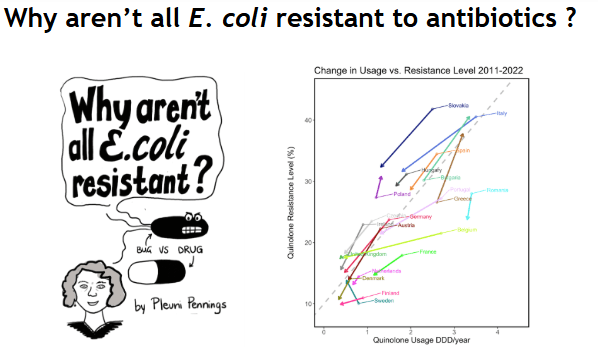
Why aren't all E. coli strains resistant to antibiotics?
(Seminar in English)
Pleuni Pennings
Department of Biology, San Francisco State University, San Francisco, USA
pennings@sfsu.edu
Friday, March 28
CEFE – Large Meeting Room – 11:30 a.m.
1919 Route de Mende, Montpellier
The seminar will also be streamed live online.
Link to the seminar:https://umontpellier-fr.zoom.us/webinar/register/WN_zgLs6hEhTxSlPV2sPbMsRQ
Campus access (register before 11 a.m. on SEEM day):https://duo.dr13.cnrs.fr/public/evenement/index
Abstract
We do not know why drug-resistant strains and susceptible strains often coexist, nor do we know what determines the level of resistance in a pathogen population (e.g.,E. coli,S. pneumoniae, HIV). However, there is much wedoknow: we know that resistance levels often remain stable over the years; we know that resistance levels depend on drug use at the national level; and we know that resistance often results from many independent acquisition events (whether through mutation or horizontal gene transfer). Here, I present a simple population-genetic model, similar to mutation-selection balance, that can explain all these observations.