Convergences and Divergences Among Species in Sympatry: The Case of Morpho Butterflies
(Seminar in English)
Vincent Debat
ISYEB, National Museum of Natural History, Paris, France
vincent.debat@mnhn.fr
Friday, April 4, 2025
CEFE – Large Meeting Room – 11:30 a.m.
1919 Route de Mende, Montpellier
The seminar will also be streamed live online.
Link to the seminar:https://umontpellier-fr.zoom.us/webinar/register/WN_-J3blYapQa-xsBLSPXsAow
Campus access (register before 11 a.m. on SEEM day): https://duo.dr13.cnrs.fr/public/evenement/index
Abstract
How do closely related species coexist in the same habitat? What are the consequences of their interactions on their phenotypes? The importance of species interactions for speciation and phenotypic evolution is poorly understood.
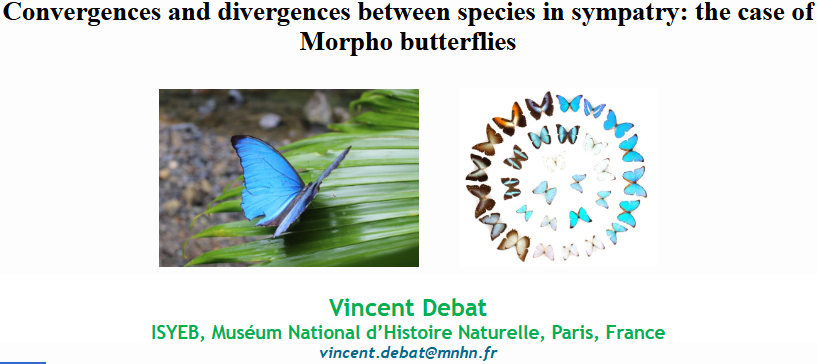
Negative interactions, such as competition, have received much attention and may promote character displacement, driving divergence among species. However, positive interactions may also strongly influence the evolution of sympatric species. For example, in chemically protected species, mimicry may drive local convergences. Such convergences might, in turn, intensify competition, with consequences that are difficult to predict. I will illustrate these questions by presenting the work conducted by our team on butterflies from the neotropical genus Morpho. Morpho butterflies are famous for their iridescent blue colors, but the evolutionary drivers of their diversification are largely unknown. Many Morpho species are sympatric, with up to 12 species found in the same localities of northern Peru: what are the consequences of such coexistence on their evolution? I will first focus on the evolution of wing shape and flight, illustrating local divergences likely related to competition. I will then present some work on the evolution of color patterns and iridescence, showing repeated local convergences. How these convergences, in turn, affect sexual interference and trigger the evolution of other traits is currently under investigation—and I will provide an overview of our ongoing projects.