Tipping Points in Coupled Human-Environment Systems
(Seminar in English)
Dr. Madhur Anand, Professor
School of Environmental Sciences, University of Guelph, Canada
manand@uoguelph.ca
Friday, March 7, 2025
CEFE – Large Meeting Room – 11:30 a.m.
1919 Route de Mende, Montpellier
The seminar will also be streamed live online.
Link to on-site registration:https://duo.dr13.cnrs.fr/public/evenement/index
Link to the seminar:https://umontpellier-fr.zoom.us/webinar/register/WN_oMBd8o5gQJ2x5os-9duHLw
Abstract
Humans and the environment form a single complex system in which humans not only affect ecosystems but also respond to those effects.
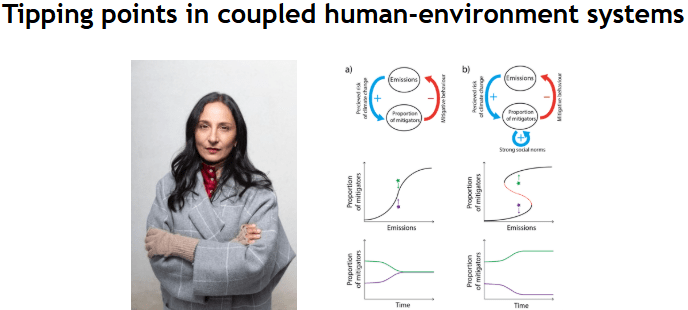
Mathematical models of coupled human-environment systems (CHES) are essential for understanding the impacts of social behavior and interventions, as well as their potential to prevent catastrophic environmental events. Sustainable trajectories over multi-decadal timescales can be explored using relatively simple models. These models demonstrate how social parameters, as well as the degree of human influence on environmental systems, can profoundly affect the number and type of tipping points that may occur through bifurcations to alternative stable states. Additionally, the effectiveness of early warning signals can be altered through this coupling, offering the potential to monitor environmental systems using social data. The coupled study systems presented here include models of forests and land use, coral reefs and fishing, and invasive species.