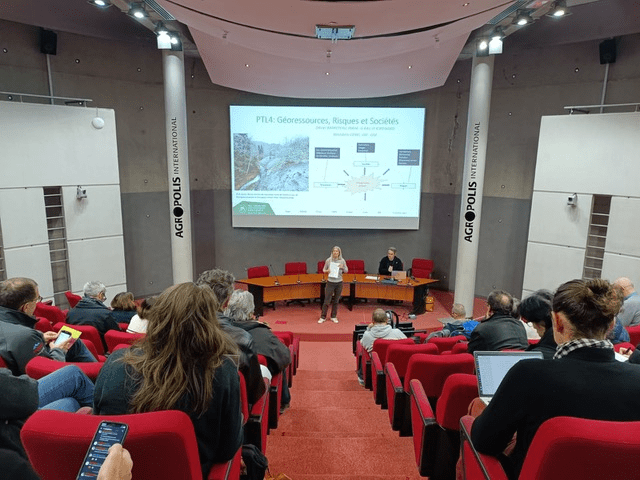
PTL4 – Georesources, Risks, and Societies
For more information on the latest news about the PTL4:
Governance
Co-coordinators:Jean-Stéphane Bailly (AGROPARISTECH) and Bénédicte CENKI (UM)
Steering Committee
- Olivier BARRETEAU (Co-coordinator, INRAE)
- Bénédicte CENKI (Co-coordinator, UM)
- Benoit ILDEFONSE (GM, UM)
- Patrick LACHASSAGNE (HSM, UM)
- Flavie CERNESSON (rep) (TETIS, AGROPARISTECH)
- Frédéric JACOB (rep) (LISAH, IRD)
- Frédéric FEDER (Recycling and Risks, CIRAD)
- Stéphane GHIOTTI (rep) (Art-DEV, UM)
- Katrin ERDLENBRUCH (rep) (CEE-M, INRAE)
- Alex MILCU (Ecotron, CNRS)
- Renaud HOSTACHE (rep) (Espace-Dev, IRD)
- Julie MENDRET (rep) (IEM, UM)
- Eleonore LOISEAU (rep) (ITAP, INRAE)
- Ronan LE VELLY (DU), Laure HOSSARD (rep) (Innovation, SUPAGRO)
- Jérôme HARMAND (rep) (LBE, INRAE)
- Céline CASENAVE (MISTEA, INRAE)
- Julien MARY (rep) (MSH-Sud, CNRS)
- William’s DARE and Chloé NICOLA-ARTERO (reps) (SENS, CIRAD)
- Flavie CERNESSON (rep) (TETIS, remote sensing)
- Marcel KUPER (G-EAU, CIRAD)
19 units assigned to PTL4
Main:
- ECOTRON
- MEANING
- GECO
- OREME
- TETIS
- ChimEco
- HSM
- LISAH
- GM
- LBE
- G-EAU
- IATE
- INNOVATION
- ITAP
- Recycling & Risk
- VASSAL
Secondary:
- CEE-M
- MISTEA
- MSH SOUTH
Calls for Proposals
In Progress
Past
Call for Ideas for the Collaborative Development of the PTL4 “
” Structuring Projects
The PTL4 scientific community shares the goal of placing georesources (water, soil, minerals) back at the heart of our societies in transition, understanding and anticipating hazards in the context of the impacts of global change, and planning for their sustainable management in the face of environmental risks. The goal is therefore to explore the links between natural resources, geological and climatic hazards, and how societies adapt to ensure more resilient land management. To achieve this, we must analyze resource cycles and their uses (formation, renewal, circulation), understand and monitor the factors determining exposure to hazards, and ultimately integrate this knowledge to design appropriate governance strategies. The goal is to propose solutions for the sustainable management of natural resources, reduce vulnerabilities to risks, and fully integrate the humanities and social sciences into environmental management.
One of PTL4’s flagship initiatives is to support 3 to 4 interdisciplinary, transformative projects (lasting 3 to 4 years, with the possibility of a thesis; approximately €250,000 each, for a total of €750,000) that must align with the above objective. These projects will be developed collaboratively by the PTL4 units (as well as, potentially, other units within the AEB Cluster and I-Site) and will receive support from the PTL4 Steering Committee, according to the following process:
Scope of the First Call for Proposals for PTL4 – Long 4 Thematic Projects: Georesources, Risks, and Societies
Submission deadline: April 7, 2025, 5:00 p.m .
Long-term thematic projects (2025–2029) are the University of Marseille’s new tools for funding and organizing scientific research, following in the tradition of the Labex programs.
PTL 4 addresses the theme of georesources (i.e., water, soil, and all mineral and energy resources except fossil fuels) and their uses, which are essential to the sustainability of socio-ecosystems.
changes in lifestyles, and population growth are increasing
societies’ sensitivity to the availability of these resources in the right place, at the right time, and in the right quantity and quality. It is essential to better understand the complex processes that determine the evolution of these resources, their availability and uses, as well as the risks faced by the societies that depend on them and the institutional and technical frameworks for their governance that promote adaptation and resilience. Global changes thus require us to reassess our understanding of the processes driving territorial evolution—including their social, geological, pedological, and hydrological components—in order to propose robust and relevant adaptation strategies. The PTL Georesources, Risks, and Societies aims to generate knowledge by combining three areas—georesources, risks, and societies—to understand the determinants of territorial dynamics related to the availability of georesources and their exposure to risks, and to develop robust adaptation strategies.
Coming Soon
Activities
2025 Kickoff