"EPPAQ" Project
Assess, protect, and preserve environments by adapting water quality to meet various uses under human pressure
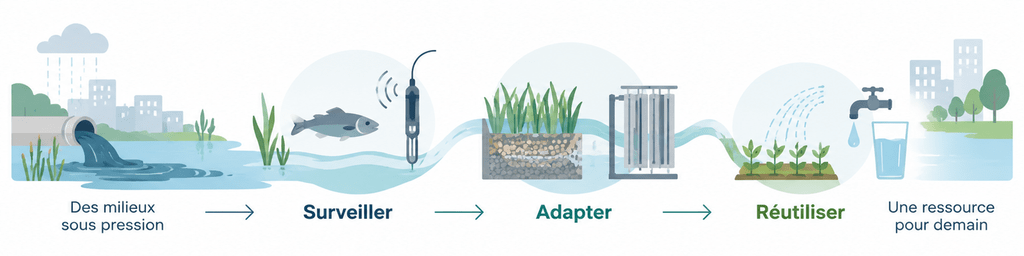
In response to increasing anthropogenic pressures and the diversification of water uses, the EPPAQ project aims to develop approaches that will both tailor water quality to specific uses and improve its assessment. To achieve this, it relies on “flexible” treatment systems and various types of “monitors” capable of providing information on water quality and its changes over time.
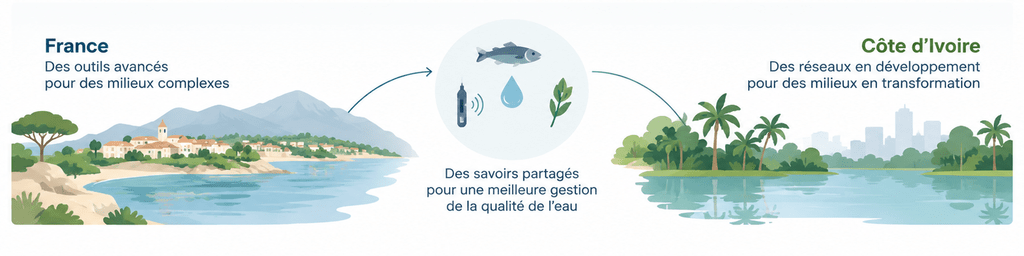
In France, EPPAQ will develop hybrid systems combining bio-inspired and membrane-based processes to produce different grades of water for reuse. At the same time, a new biomonitoring tool will be developed based on the molecular responses of sentinel organisms exposed to gradients of environmental stress, in order to assess the ecological quality of both natural waters and treated waters.
In Côte d’Ivoire, the project will strengthen monitoring of the Aghien Lagoon—a strategic resource for Abidjan’s water supply—to better understand the dynamics of eutrophication and salinization. It will also study the sentinel sociotechnical systems—comprising sensors, scientists, managers, and institutions—that generate, interpret, and disseminate information on water quality.
By fostering dialogue between these approaches and contexts, EPPAQ aims to shift from a prescriptive approach to water quality to a functional one tailored to specific uses, while strengthening resource protection and the circularity of water.
Affiliated laboratories:
- LBE: Rémi Servien, Dominique Patureau, Jérôme Harmand
- HSM-ConteM: Courant Frédérique, Gomez Elena, Duporté Geoffroy, Lacrampe Nathalie, Orange Didier
- HSM-H2U: Romain Leclercq, Jean-Louis Perrin
- IMT-ConteM: Andrés Sauvêtre, François Lestremau, Gratia Deii Flores Salgado, José Manuel Tunqui Neira
- MARBEC: Emilie Farcy
- IEM: Marc Héran, Geoffroy Lesage
- GEAU: Anne-Laure Collard, Nassim Ait-Mouheb
- MISTEA: Alain's Report