"WISE-ADAPT" Project
The Role of Water and Salt in Complex Geological Systems: From Risk to Adaptation
The Role of Waterand Salt in theImbalanceof Complex GeologicalSystems: From Hazard to Adaptation(WISE-Adapt)
Against a backdrop of climate change and increasing pressure on natural resources, geological systems are subject to imbalances that can lead to major environmental and societal risks. The WISE-Adapt project focuses on hazards related to groundwater flow and the presence of salt as a factor that exacerbates or determines environmental imbalance. It studies three phenomena in particular: i) tectonic deformation of evaporitic and carbonate karst sedimentary deposits, where salt is initially present in the geological system and leached out by water flow; ii) seawater intrusion into coastal aquifers; iii) landslides in which the presence of salt can act as an additional factor contributing to slope instability.
These hazards pose risks to society: water salinization can compromise water quality and pose a risk to human health; the use of saline water in agriculture can reduce crop yields; and landslides endanger homes, businesses, and infrastructure. This raises the question of how to better anticipate these natural phenomena, design early-warning systems, and encourage behavioral changes to reduce the associated risks.
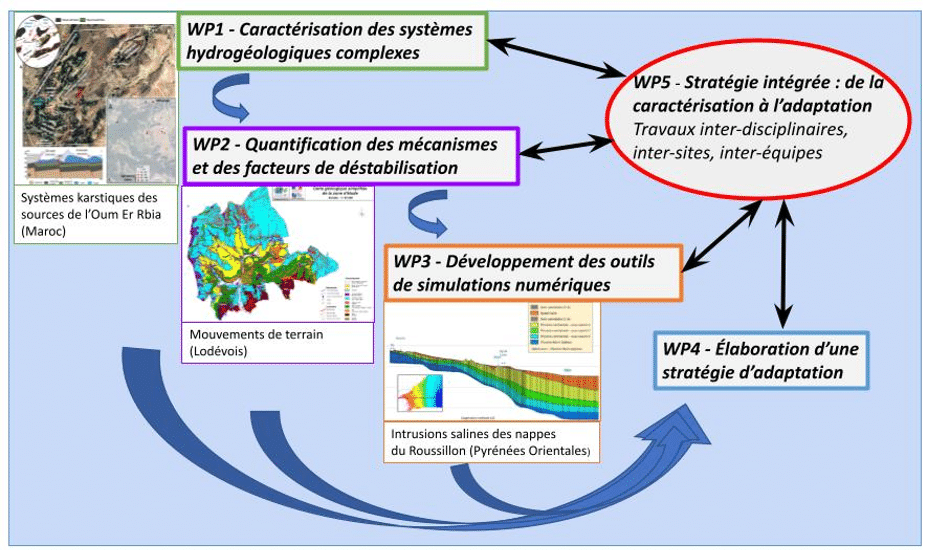
The project is based on three Mediterranean study sites: the Oum Er Rbia site in Morocco, which addresses issues related to the impact of salt tectonics on hydrosystems, the Pégairolles de l’Escalette site in the Lodève region, which addresses issues related to landslides; and the Pliocene-Quaternary aquifer in Roussillon, which addresses issues related to saline seawater intrusion. These three sites, which are at different stages of hazard characterization and the development of management tools, will enable the project to integrate knowledge and methodological approaches.
WISE-Adapt is structured to follow these steps (Fig. 1):
- Characterize the environment where the hazard is present by defining the geological context and the key physicochemical processes occurring there (WP1)
- Describe and quantify the factors that trigger the hazard and the stabilization mechanisms (WP2)
- Develop reliable digital prediction tools to conduct multifactorial analyses of hazard occurrence and simulate trigger and stabilization scenarios (WP3).
- Develop early warning and adaptation strategies based on realistic models, including monitoring of adaptive behaviors. This requires having first identified the challenges and behaviors of stakeholders in at-risk areas (WP4).
This organizational structure enables us to offer an original and integrated approach, ranging from the characterization of physical processes to the development of early warning and adaptation strategies, by bringing together geosciences, hydrogeology, geography, and economics (WP5). This interdisciplinary approach is reflected in particular through fieldwork aimed at characterizing physical and societal phenomena, as well as through experimental economics research designed to analyze user behavior in response to risks and early warning systems. The project will help improve risk anticipation and management, while promoting sustainable water resource management. It is designed to contribute to the development of operational tools for local stakeholders.
Coordinators: Delphine Roubinet (CNRS, GM) and Katrin Erdlenbruch (INRAE, CEE-M)
Duration: 48 months (October 2026 – October 2030)
Budget: 307,000 euros
Laboratories and principal investigators (WP leaders):
Géosciences Montpellier (GM): Grégory Ballas, Stéphanie Gautier, Delphine Roubinet,
Center for Environmental Economics Montpellier (CEE-M): Katrin Erdlenbruch
Hydrosciences Montpellier (HSM): Véronique Léonardi